
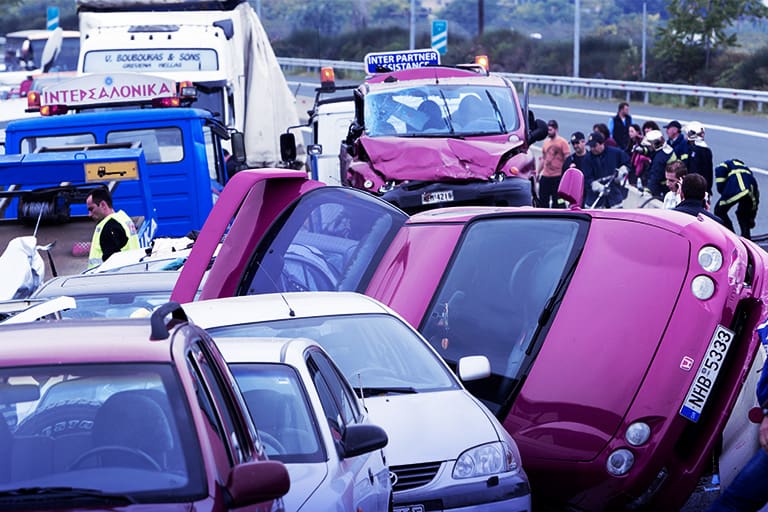
Anyone who has called a San Mateo personal injury attorney after a five-car crash on 101 knows the first question isn’t “how much is my case worth.” It’s “how do they even figure out who caused this mess.” Multi-vehicle pileups are some of the messiest claims in personal injury law, and the way fault gets assigned rarely matches what actually happened on the road.
A rear-end collision between two cars is fairly straightforward. Car B hit Car A, Car B is probably at fault, done. Add three or four more vehicles into the chain, throw in a lane change, a patch of black ice, and a driver who was checking a text at the wrong moment, and the picture changes fast. Insurance adjusters love these cases precisely because the confusion gives them room to argue.
How Fault Actually Gets Determined
California follows a pure comparative negligence rule, which means fault doesn’t have to land entirely on one driver. It can be split five ways, sixty-forty, or any combination that reflects what the evidence shows. A jury or insurance company can assign you 20 percent fault and still owe you 80 percent of your damages. That single fact changes the entire strategy behind these cases, because insurers know that shifting even a small percentage of blame onto you reduces what they have to pay.
Reconstructing a pileup usually comes down to a few sources of evidence:
- Police reports, though officers often arrive after the scene has already been cleared and rely heavily on driver statements
- Vehicle damage patterns, which can show the sequence of impacts based on where and how hard each car was struck
- Event data recorders (the “black box” in most modern cars), which log speed, braking, and throttle position in the seconds before a crash
- Traffic camera or dash cam footage, when it exists
- Witness statements from drivers who were far enough back to see the whole sequence unfold
The order of impact matters enormously. If Car C was pushed into Car B by Car D, then Car B’s driver may bear little or no responsibility even though their vehicle hit the car in front of them. This is where a lot of injured people get blindsided. They assume that because their bumper touched the car ahead, they’re automatically on the hook. That’s not how California law works, and it’s not how physics works either.
Chain Reactions and the “Sudden Emergency” Problem
A common defense in these cases is the sudden emergency doctrine, essentially the argument that a driver couldn’t have avoided the crash because they were reacting to something unexpected. Fog rolling in off the bay, a truck jackknifing ahead, a sudden stop from traffic that had been moving fine seconds earlier. Insurers lean on this defense constantly, sometimes appropriately and sometimes as a way to avoid paying a legitimate claim.
The problem is that “sudden emergency” has limits. Following too closely for conditions, speeding, or failing to leave adequate stopping distance can defeat the defense even in genuinely chaotic circumstances. Fault analysis in a pileup isn’t just about who hit whom. It’s about who had a reasonable opportunity to avoid the collision and didn’t take it.
Why Insurers Get It Wrong (Sometimes on Purpose)
Adjusters handling multi-vehicle claims are working from incomplete information, often within days of the crash, before all the physical evidence and data have been pulled together. Some of the errors are honest. A lot of them aren’t. It’s not unusual for an insurance company to assign fault to whichever driver has the least documentation or the weakest initial statement, simply because that’s the path of least resistance for closing the file cheaply.
There’s also the matter of multiple insurers negotiating with each other. When five vehicles are involved, you may have five different carriers, each trying to minimize their own client’s share of liability. Your claim can get caught in the middle of that negotiation, and the percentage you’re offered may have more to do with which insurer blinked first than with what the evidence actually supports.
This is precisely the kind of situation where having someone independently reconstruct the crash, rather than accepting the insurer’s version of events, makes a measurable difference in outcome. Physical evidence, data recorder information, and witness accounts often tell a different story than the initial police report, and that story is what actually determines what you’re owed.
What to Do If You’re Caught in a Pileup
Document everything you can before you leave the scene, even if it feels excessive in the moment. Photos of vehicle positions, skid marks, and damage from multiple angles are worth more than they seem at the time, especially once vehicles get towed and the scene disappears. Get contact information from anyone who witnessed the sequence, not just the people directly involved.
Be careful with early statements to insurance adjusters. Saying “I think I might have been going a little fast” or “I’m not sure how it happened” can be used against you later, even if you were simply being honest and uncertain in a stressful moment.
Multi-car accidents are rarely simple, and the fault percentages that get assigned in the first few weeks are often wrong, sometimes in ways that cost injured people real money. If you were hurt in a chain-reaction crash and the story the insurance company is telling doesn’t match what you remember happening, it’s worth having someone take a closer look before you settle for a number based on incomplete evidence.